
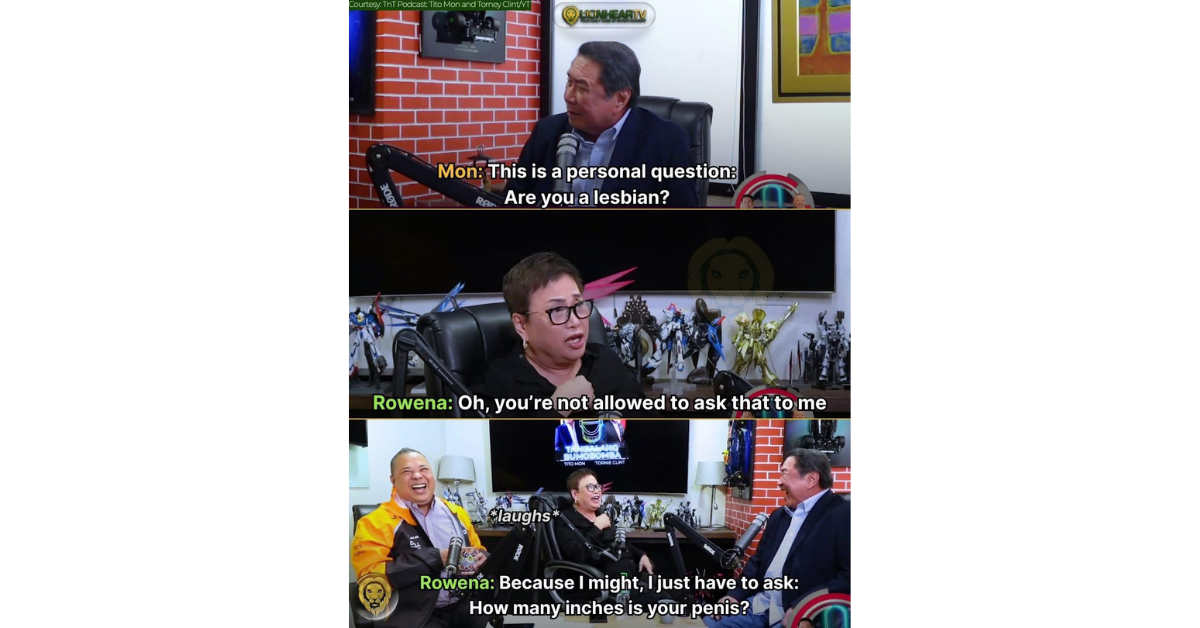
MANILA — A controversial exchange between broadcaster Ramon “Mon” Tulfo and former Commission on Elections commissioner Atty. Rowena Guanzon has sparked debate on boundaries in public discourse.
During a recent interview, Tulfo asked Guanzon, “This is a personal question. Are you a lesbian?” The query was met with immediate pushback. Guanzon retorted, “Oh you’re not allowed to ask me that. Because I might, I just have to ask: How many inches is your penis?”
Crossing the Line on Air, Then Pointing Fingers After
Ramon "Mon" Tulfo asked a question that never needed to be asked. Rowena Guanzon responded with one that made the point painfully clear. What followed was laughter, outrage, applause, and a familiar online divide.
At its core, the exchange was simple. Sexual orientation is private. It has no bearing on public service, legal thinking, or credibility. Tulfo’s question crossed a line, not because it was offensive entertainment, but because it treated identity as fair game for curiosity. Guanzon’s comeback worked because it mirrored the intrusion. It forced listeners to feel the discomfort she was placed in.
That moment resonated because many people have experienced the same thing. Questions that are framed as casual, even playful, but leave someone exposed. In that sense, Guanzon’s response landed. It reminded audiences that invasiveness is not harmless just because it comes with a microphone.
The problem with selective outrage and convenient standards
But the conversation cannot stop there.
Guanzon’s sharp reply earned praise, yet it also reopened an uncomfortable truth. She has, in the past, made remarks about the sexuality of people she disagreed with online, sometimes using it as an insult. That history complicates the applause.
Respect loses meaning when it is applied only in moments that benefit us. Calling out an intrusive question is valid. Demanding boundaries is valid. But those demands ring hollow if the same boundaries are crossed in reverse when anger takes over.
This is where the real issue lies. Public discourse has become a contest of who can embarrass whom faster. Journalists push limits for clicks. Public figures push back with viral lines. The crowd cheers whichever side feels right in the moment.
Lost in that cycle is consistency.
If sexual orientation is private, it should stay private in all directions. Not as a shield used selectively. Not as a punchline. Not as a weapon during arguments.
This incident should have been a reset. For broadcasters to remember that not everything personal is public. For public figures to remember that dignity is not situational.
The harder question now is this. Are we actually interested in raising standards, or do we just enjoy moments where disrespect happens to land on the other side? And if boundaries only matter when we are offended, what kind of public conversation are we really building?