
Marcos rolls out red carpet for 343 rescued OFWs
Marijo Farah A. Benitez • Ipinost noong 2026-03-23 17:51:44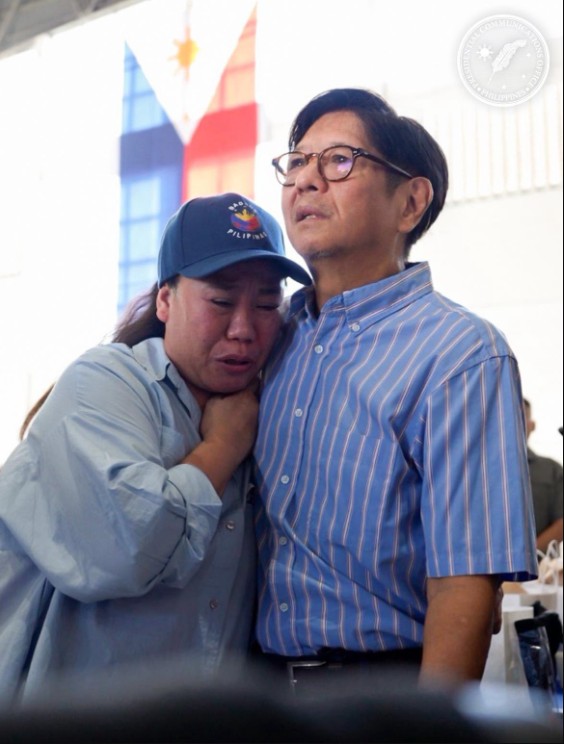
MARCH 23, 2026 — President Ferdinand Marcos Jr. personally welcomed 343 repatriated OFWs from the Middle East at Villamor Air Base, marking the fourth government-chartered flight amid escalating regional tensions. The administration promises financial aid, reintegration programs, and job opportunities, but the bigger question is whether these efforts can truly sustain displaced workers long-term.
At 6:30 a.m. on March 23, 343 Filipinos — 317 OFWs and 26 dependents — touched down in Pasay City aboard a Philippine Airlines chartered flight. President Marcos was there, shaking hands, offering smiles, and promising support. It was a symbolic gesture, one meant to reassure the public that the government is on top of the crisis.
But beyond the optics, the reality is sobering: thousands more remain stranded in the Middle East, with at least 1,200 Filipinos expected to be repatriated in the coming days.
Department of Migrant Workers Secretary Hans Leo Cacdac revealed that many OFWs had to endure grueling land crossings due to restricted airspace in Kuwait, Qatar, and Bahrain.
“Sarado ang airspace in Bahrain and limited or restricted ang airspace sa Kuwait and Qatar. So it was a land-crossing effort. It took, on average, about seven to eight hours to get to Riyadh, Saudi Arabia,” he said.
This detail underscores the precariousness of the situation — Filipinos are not just fleeing jobs, they’re fleeing danger. Saudi Arabia’s role as a hub for evacuation highlights the fragile geopolitics that directly affect our kababayans.
The government has lined up financial aid, hotel accommodations, domestic flights, and free bus rides for returning OFWs. Agencies like DOLE, DTI, DOT, DA, and TESDA are stepping in with job opportunities, livelihood programs, and reskilling courses.
But how many of these OFWs will actually find stable jobs here? How many will be forced to leave again once the dust settles?
This repatriation effort is not just about logistics; it’s about the Philippines’ dependence on overseas labor. Every crisis abroad exposes the fragility of our economy’s reliance on remittances. Marcos’ emphasis on “bayanihan” is noble, but bayanihan cannot replace systemic reform. If we continue exporting labor without building industries at home, we will always be at the mercy of foreign conflicts.
Are we content with applauding every repatriation flight, or do we demand a future where our workers no longer need to risk their lives abroad just to survive? How many more welcome ceremonies must we hold before the Philippines finally stops exporting its people as its biggest product?
(Image: Presidential Communications Office | Facebook)