
China builds biggest island yet in South China Sea — what does this mean for us?
Marijo Farah A. Benitez • Ipinost noong 2026-04-29 18:12:10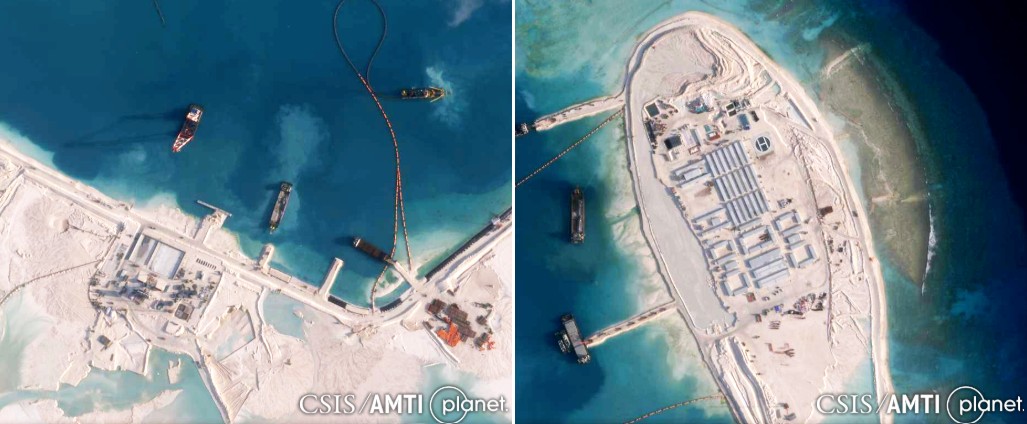
APRIL 29, 2026 — China’s massive new reclamation at Antelope Reef in the Paracel Islands — already spanning nearly 1,490 acres — marks its biggest island-building push in the South China Sea since 2017, raising alarms across Asia and sparking questions about how this move reshapes regional power dynamics. For Filipinos, the development is a stark reminder of how Manila’s own claims in the Spratlys remain vulnerable amid Beijing’s relentless expansion.
Satellite imagery analyzed by the Asia Maritime Transparency Initiative (AMTI) shows China has reclaimed about 1,490 acres of land at Antelope Reef, nearly matching the size of Mischief (Panganiban) Reef at 1,504 acres — the largest Chinese outpost in the Spratlys. The reef, once one of China’s smallest holdings in the Paracels, now rivals the scale of Beijing’s “big three” bases: Mischief, Subi (Zamora), and Fiery Cross (Kagitingan).
The new landmass could accommodate a 9,000-foot runway, harbors, and extensive military infrastructure — surveillance systems, missile facilities, underground storage, and electronic warfare installations. Analysts note the straightened edges of the reclaimed reef appear deliberately designed for airstrip construction.
The Paracel Islands, where Antelope Reef sits, are claimed by both China and Vietnam, though Beijing has controlled them since the 1970s. The reef lies just 216 nautical miles from Da Nang, Vietnam, and about 162 nautical miles from Hainan, China, positioning it as a forward base that extends China’s reach deeper into contested waters.
AMTI warns the expansion could support naval, coast guard, and maritime militia operations, strengthening China’s ability to project power in the northern South China Sea. While it may not immediately shift the balance of power, it sends a clear signal to Hanoi — and indirectly to Manila — that Beijing can and will expand its occupied features whenever it chooses.
The Philippine perspective
For Filipinos, this development is more than a distant headline. China has already built sprawling bases on reefs claimed by the Philippines as part of the Kalayaan Island Group, including Mischief, Subi, and Fiery Cross. Each of these outposts hosts airstrips, ports, and military facilities that dwarf anything Manila has in the area.
The Antelope Reef project underscores a sobering reality: China’s island-building machine is back in motion, and the Philippines remains caught between asserting sovereignty and managing economic ties with Beijing.
While Vietnam is the immediate neighbor affected, Manila cannot ignore the precedent — if China can expand in the Paracels, what stops it from further fortifying the Spratlys?
The South China Sea is not just about geopolitics — it’s about livelihoods. Millions of Filipinos depend on its fisheries, and the waters are vital shipping lanes for our economy. Every new Chinese runway or missile site raises the risk of militarization, restricting access and heightening tensions that could spill over into trade, energy security, and food supply.
How much longer can we afford to watch China redraw the map of the South China Sea without a stronger, united response?
(Image: Asia Maritime Transparency Initiative)