
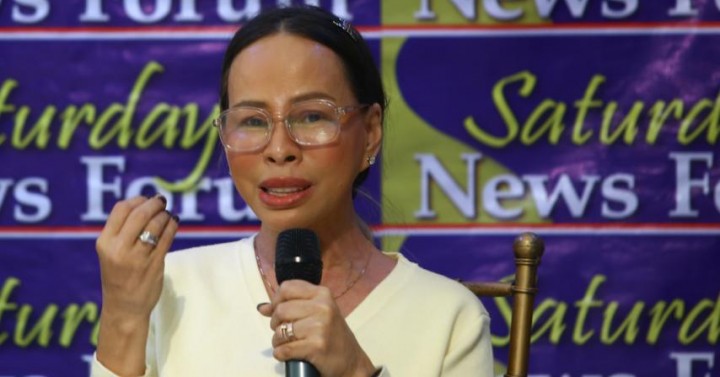
MANILA — The camp of the late Department of Public Works and Highways (DPWH) Undersecretary Catalina Cabral revealed that she had made several attempts to harm herself before her death, citing depression and the fallout from corruption allegations involving flood control projects.
In an interview, Cabral’s lawyer Atty. May Divina Gracia said her client’s struggles began after she was dismissed from the DPWH despite serving for 40 years. “Although under the guise of a courtesy resignation, she was summarily dismissed from the DPWH after 40 years of service. And when she was denied her retirement pay, she felt that she was being used as a scapegoat for the men or the individuals who are really culpable or responsible for this flood control mess,” Divina Gracia explained.
The lawyer added that Cabral’s mental health worsened after former Undersecretary Roberto Bernardo implicated her in the alleged anomalies. “We’ve ruled out the possibility of foul play where there’s no clinical diagnosis, but layman’s perspective, we’ve observed how she spiraled into depression. There was already a previous attempt to harm herself… just days after the hearing where former Undersecretary Bernardo implicated her. That was just the tipping point,” she said.
Cabral reportedly lamented her situation, saying: “Ma’am, anong ginawa ko? Sumunod lang ako. I was just being a good soldier. Ever since, from the time of Secretary Singson, the time of Secretary Villar, to the time of Secretary Bonoan. So there’s no truth to the allegations that she was the most powerful.”
Meanwhile, Divina Gracia confirmed that Batangas 1st District Rep. Leandro Leviste had taken documents from Cabral’s office prior to her death. She also disclosed that six boxes of files containing names of project proponents and congressional requests are currently missing. “She showed us six boxes of documents. I’ve seen a document that’s ostensibly similar to the document that was released by Congress… but I cannot say with absolute certainty that it’s the same because I have not seen the entire document,” the lawyer said.
The whereabouts of the boxes remain unknown. “Nasaan siya? Yun ang hindi namin alam… because before she passed on, she was supposed to give it to us. We don’t have it in our possession. We don’t know where it’s stashed at the moment,” Divina Gracia added.
Authorities continue to investigate the circumstances surrounding Cabral’s death, as well as the missing documents linked to the controversial flood control projects.
When a name becomes so tainted, even death is doubted
Catalina Cabral died, yet many people did not believe it. Some whispered that she faked her death. Others claimed she was seen abroad. Online, disbelief moved faster than sympathy.
That reaction did not come out of nowhere. Cabral had become a symbol of corruption in the public mind, fairly or not. Flood control projects, missing documents, power plays. Her name had been judged long before any final accounting. By the time news of her death broke, credibility was already gone.
That is the cruel reality of public life. Once a person is widely seen as corrupt, truth becomes optional to the crowd. Even death is treated with suspicion. And when that happens, something deeply human is lost. Not just trust in institutions, but empathy itself.
A Name So Tainted, Even Death Is Not Believed
Catalina Cabral is dead, yet many Filipinos refuse to believe it. Rumors spread quickly. Some claim she faked her death. Others insist she was seen abroad. For a public figure, disbelief can follow scandal. But doubting death itself says something darker.
Cabral’s name had become synonymous with corruption allegations tied to flood control projects. Long before her death, the public had already decided who she was. Guilt came first. Proof felt optional. By the time the news broke, trust was gone so completely that even facts could not survive it.
That is not just about Cabral. It is about what happens to credibility in public life.
Judgment arrived early, resolution never did
According to her lawyer, Cabral struggled with depression, felt scapegoated, and attempted to harm herself more than once. She believed she was being blamed for a system she did not fully control. Those claims do not erase allegations. They do not rewrite history. But they do complicate it.
This is where the public reaction becomes uncomfortable.
Accountability demands scrutiny. It demands evidence. But what Cabral faced was not just scrutiny. It was final judgment without final answers. Allegations hardened into identity. And once that happened, there was no room left for nuance, or even doubt.
That is why disbelief followed her death. In the public mind, she had already been reduced to a symbol, not a person.
Death exposed what the system never resolved
Cabral’s death did not close the case. It froze it.
Documents are missing. Allegations remain unresolved. The people who accused her are still alive. The systems she worked under remain intact. And the person who could answer questions is gone.
That is the real failure here.
If Cabral was guilty, justice will never fully be served. If she was partly scapegoated, that injustice will also never be corrected. Either way, the system failed to deliver clarity before it delivered condemnation.
And when institutions fail, the public fills the silence with anger and speculation.
What it costs when credibility dies first
The most troubling part of this story is not disbelief. It is acceptance of disbelief.
We have grown comfortable deciding who deserves truth, sympathy, or dignity. We are quick to say some people no longer qualify. That mindset may feel satisfying in moments of rage, but it comes at a cost.
Because once credibility can be destroyed without resolution, anyone can be next.
Cabral’s death forces a hard question. Are we content with judgment that arrives early and answers that never arrive at all? And if even death cannot restore basic belief, what does justice mean anymore, and who do we trust to deliver it?