
UP graduate tops 2025 Bar exams as passing rate rises to 48.98%
Margret Dianne Fermin • Ipinost noong 2026-01-07 16:26:20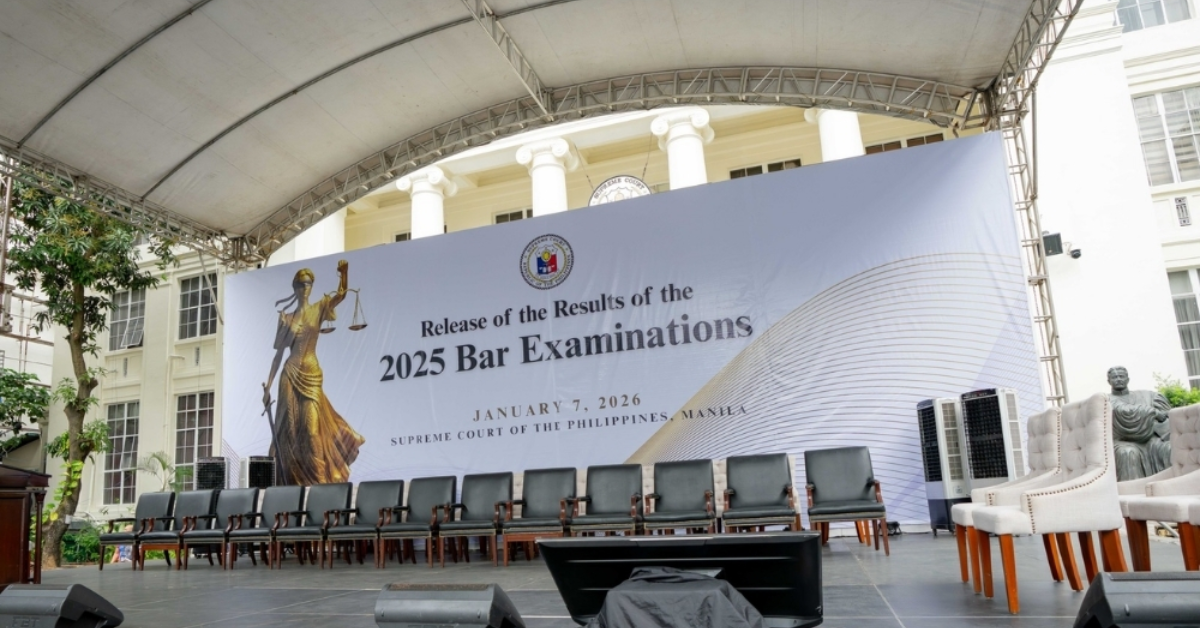
MANILA — The Supreme Court announced on Wednesday that Jhenroniel Rhey Timola Sanchez of the University of the Philippines topped the 2025 Bar Examinations with a score of 92.70%, leading a new generation of lawyers who passed with a significantly higher success rate compared to the previous year.
Associate Justice Amy Lazaro-Javier, Bar Chairperson, reported that 5,594 out of 11,420 examinees passed, translating to a 48.98% passing rate, a notable increase from 2024’s 37.84%.
Here are the Top 10 Bar Topnotchers for 2025:
- Jhenroniel Rhey Timola Sanchez — University of the Philippines (92.70%)
- Spinel Albert Allauigan Declaro — University of Santo Tomas-Manila (92.46%)
- Alaiza Agatep Adviento — University of Santo Tomas-Manila (91.91%)
- Angelica de Castro Mitra — De La Salle–Lipa (91.68%)
- Marc Angelo Galvez Santos — University of Santo Tomas-Manila (91.58%)
- Jeowy Loyloy Ompad — University of San Jose-Recoletos (91.25%)
- Johan Raphael Silapan Gata — University of Santo Tomas-Manila (90.90%)
- Marie Shantelle Atienza Sarmiento — University of the Philippines (90.85%)
- John Paul Villanueva — Ateneo de Manila University (90.70%)
- Kristine Joy Ramos — San Beda University (90.55%)
A New Generation of Hope
The results of the 2025 Bar Exams are not just numbers; they represent a new generation of lawyers who carry the hopes of Filipinos for a more just society. At a time when governance is often questioned and institutions struggle with credibility, the success of these young legal minds is a reminder that justice can be renewed through integrity and service.
The fact that the University of the Philippines produced the topnotcher, alongside strong showings from UST, Ateneo, San Beda, and regional schools like De La Salle–Lipa and USJ-R, reflects the diversity of talent across the country. This diversity is crucial: it means that justice will not only be shaped in Metro Manila but also in provinces where legal services are most needed.
Filipinos hope these new lawyers will serve the people rather than power, ensuring that the law is not a privilege of the few but a shield for the many. As the Supreme Court continues reforms in the Bar exams — digitalization, regionalization, and transparency — the challenge now lies in how these passers will translate their success into meaningful service.
The editorial lesson is clear: passing the Bar is not the end, but the beginning of a lifelong duty to bring justice closer to those who need it most. In a nation where marginalized communities often struggle to access legal remedies, the role of these new lawyers is to bridge that gap.
As the 5,594 passers prepare for their oath-taking and roll signing, the country looks to them with hope — that they will embody the ideals of fairness, integrity, and compassion, and that their victories in the exam hall will become victories for ordinary Filipinos in the halls of justice.
Image from DOJ Facebook