
Trump declares U.S. control over Venezuela after Maduro arrest
Marijo Farah A. Benitez • Ipinost noong 2026-01-04 09:53:10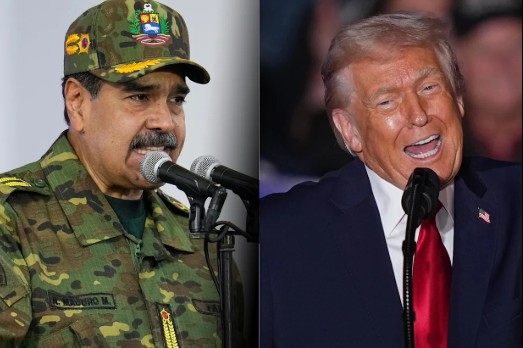
JANUARY 4, 2026 — U.S. President Donald Trump announced that American forces have taken control of Venezuela following a surprise military operation that led to the capture of President Nicolás Maduro and his wife, Cilia Flores, in Caracas.
Speaking from Mar-a-Lago in Florida, Trump said the overnight assault involved coordinated air, land, and sea strikes that dismantled Venezuela’s defenses and secured key government assets.
“We are going to run the country until such time as we can do a safe, proper, and judicious transition,” Trump declared.
Maduro and Flores are being transported to the United States to face federal indictments in New York on charges of narco-terrorism and drug trafficking. Trump accused Maduro of leading a criminal network that funneled drugs into American cities and of deploying violent gangs, including Tren de Aragua, to commit crimes on U.S. soil.
Oil and power at the center
Trump said Venezuela’s oil industry, which he described as “badly broken,” will be rebuilt with the involvement of major American companies. Revenues, he added, would be used to restore the country’s economy. The U.S. embargo on Venezuelan oil remains in place, with naval forces stationed in the Caribbean to enforce it.
“The money coming out of the ground is very substantial,” Trump said. “We’re going to get reimbursed for everything that we spend.”
Global backlash
The operation has drawn sharp criticism abroad. France’s Foreign Minister Jean-Noël Barrot said the capture of Maduro “infringes the principle of the non-use of force that underpins international law.” The European Commission expressed “great concern” over the legality of the move.
Russia’s foreign ministry condemned the action as an “act of armed aggression,” while China said it violated Venezuela’s sovereignty. Both nations had supported Maduro’s government.
In Washington, Democrats were quick to denounce the strike.
Sen. Ruben Gallego of Arizona wrote on X: “This war is illegal, it’s embarrassing that we went from the world cop to the world bully in less than one year.”
Latin American tremors
The fallout is being closely watched across Latin America. Secretary of State Marco Rubio, who pushed for the operation, warned Cuba that it could face similar consequences.
“If I lived in Havana, and I was in the government, I’d be concerned — at least a little bit,” Rubio said.
South Florida’s Venezuelan diaspora, long opposed to Maduro, celebrated the arrest. Rep. Carlos Gimenez of Florida compared the moment to the fall of the Berlin Wall, saying it “changed the course of history in our hemisphere.”
Uncertain transition
Maduro’s ouster leaves Venezuela facing a power vacuum. Opposition figures claim the rightful president is Edmundo González, an ally of Maria Corina Machado, but Trump has not committed to backing any leader.
“We can’t take a chance of letting somebody else run it — just take over where (Maduro) left,” Trump said.
Maduro had previously floated a plan to step down in three years, handing power to Vice President Delcy Rodriguez. That proposal was rejected by Washington, which questioned the legitimacy of his rule.
Rodriguez has since demanded Maduro’s release but left open the possibility of dialogue with Trump.
Impact on ordinary Venezuelans
For Venezuelans, the sudden shift raises questions about sovereignty, stability, and survival. The country has endured years of hyperinflation, shortages of food and medicine, and mass migration despite its oil wealth.
Trump insists U.S. involvement will bring “peace” and “justice,” but many fear foreign control could deepen divisions.
This development also resonates in the Philippines, where discussions on sovereignty, foreign intervention, and economic dependence often spark heated debate. Filipinos watching the crisis may ask: If a superpower can seize control of another nation overnight, what does that mean for smaller countries navigating their own political and economic challenges?
The announcement has already stirred global anxiety. Allies worry about the precedent of a U.S. takeover, while adversaries see it as a warning. The move is likely to ignite debates about international law, American dominance, and whether Venezuelans themselves will benefit from this intervention.
The question now is whether Trump’s gamble will indeed stabilize Venezuela or trigger a new wave of conflict in the region.
(Image: Yahoo)