
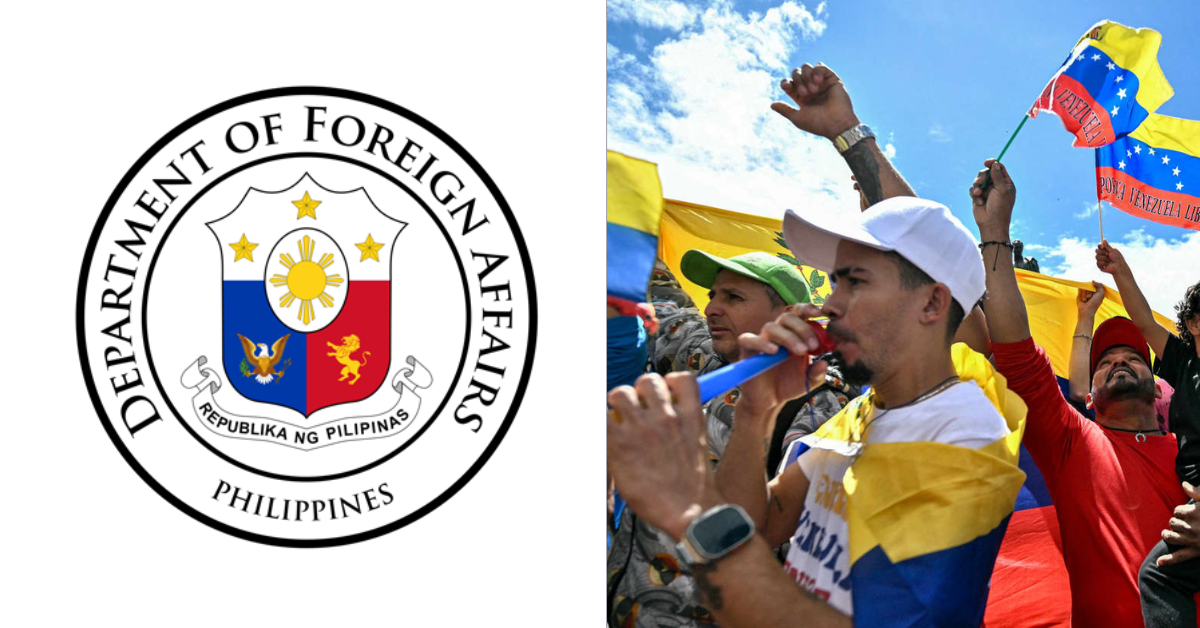
January 5, 2025 - The Philippines has expressed concern over the rapidly unfolding situation in Venezuela following the capture of President Nicolás Maduro and his wife by U.S. special forces, urging the restoration of peace and order and respect for international law.
In a statement released Monday, the Department of Foreign Affairs (DFA) said Manila is closely monitoring developments after Maduro was taken to the United States to face trial for alleged narco-terrorism. The agency warned that the incident could have broader implications for regional stability and the global rules-based order.
“The Philippines views with concern the evolving events in Venezuela and its consequential impact on peace and stability in the region as well as on the rules-based international order,” the DFA said.
While acknowledging U.S. security considerations, the DFA emphasized long-standing principles of international law, including the independence and sovereign equality of states, the peaceful resolution of disputes, the prohibition against the threat or use of force, and non-interference in the domestic affairs of sovereign nations.
At the same time, the government highlighted a more immediate concern. The safety of 74 Filipinos living in Venezuela and nearby countries. The DFA assured the public that contingency measures are in place should conditions worsen.
The statement comes as global reactions to the U.S. operation remain sharply divided. Some governments welcomed Maduro’s capture. Others condemned it as a violation of sovereignty. Analysts have warned that the operation could set a precedent for bypassing international legal processes.
Why This Matters Beyond Venezuela
At first glance, the situation may feel remote. Venezuela is far from the Philippines, and the conflict does not directly involve Southeast Asia. Yet the DFA’s careful wording signals that this is not just about one country or one leader.
The Philippines’ concern centers on how power is exercised internationally. The capture of a sitting head of state by foreign forces raises difficult questions about where legal authority begins and ends. When such actions occur outside multilateral frameworks, smaller states take notice.
This is not abstract. The Philippines relies heavily on international law, particularly the rules-based order, to assert its rights in contested spaces like the South China Sea. When those rules appear flexible for powerful nations, confidence in them weakens for everyone else.
A Delicate Position for Manila
The situation places the Philippines in a delicate position. The United States is a long-standing defense ally. At the same time, Manila consistently invokes international law to defend its own sovereignty and territorial claims.
By emphasizing both U.S. security considerations and core legal principles, the DFA is walking a careful line. It is signaling support for stability while also warning against actions that could normalize unilateral force.
Regional observers have noted that Manila’s response carries weight precisely because of this balance. The Philippines cannot afford a world where international norms are applied selectively.
The Human Dimension
Beyond geopolitics, the presence of Filipinos in Venezuela brings the issue closer to home. Overseas Filipinos often find themselves caught in the middle of conflicts not of their making. The DFA’s assurance of contingency plans reflects hard-earned experience from crises in other regions.
When global tensions rise, Filipino workers and migrants are often among the most vulnerable. Monitoring events early is not alarmist. It is a precaution.
Why Attention Matters
This is why Filipinos should care.
Not because Venezuela’s politics mirror the Philippines’. Not because the U.S. action automatically signals global conflict. But moments like this test the strength of international rules that smaller nations depend on for protection, voice, and fairness.
The DFA’s call for peace, civilian safety, and adherence to international law is not rhetorical. It is rooted in national interest. What happens when global powers act outside established norms eventually shapes what is considered acceptable elsewhere.
The situation in Venezuela is still unfolding. How it is resolved, peacefully or otherwise, will influence how force, law, and sovereignty are understood in the years ahead. For a country that relies on those principles to safeguard its own interests, indifference is not an option.