
Motorist penalized for facebook post of modified muffler — Can social media evidence define a traffic violation?
Robel A. Almoguerra • Ipinost noong 2026-03-06 23:35:56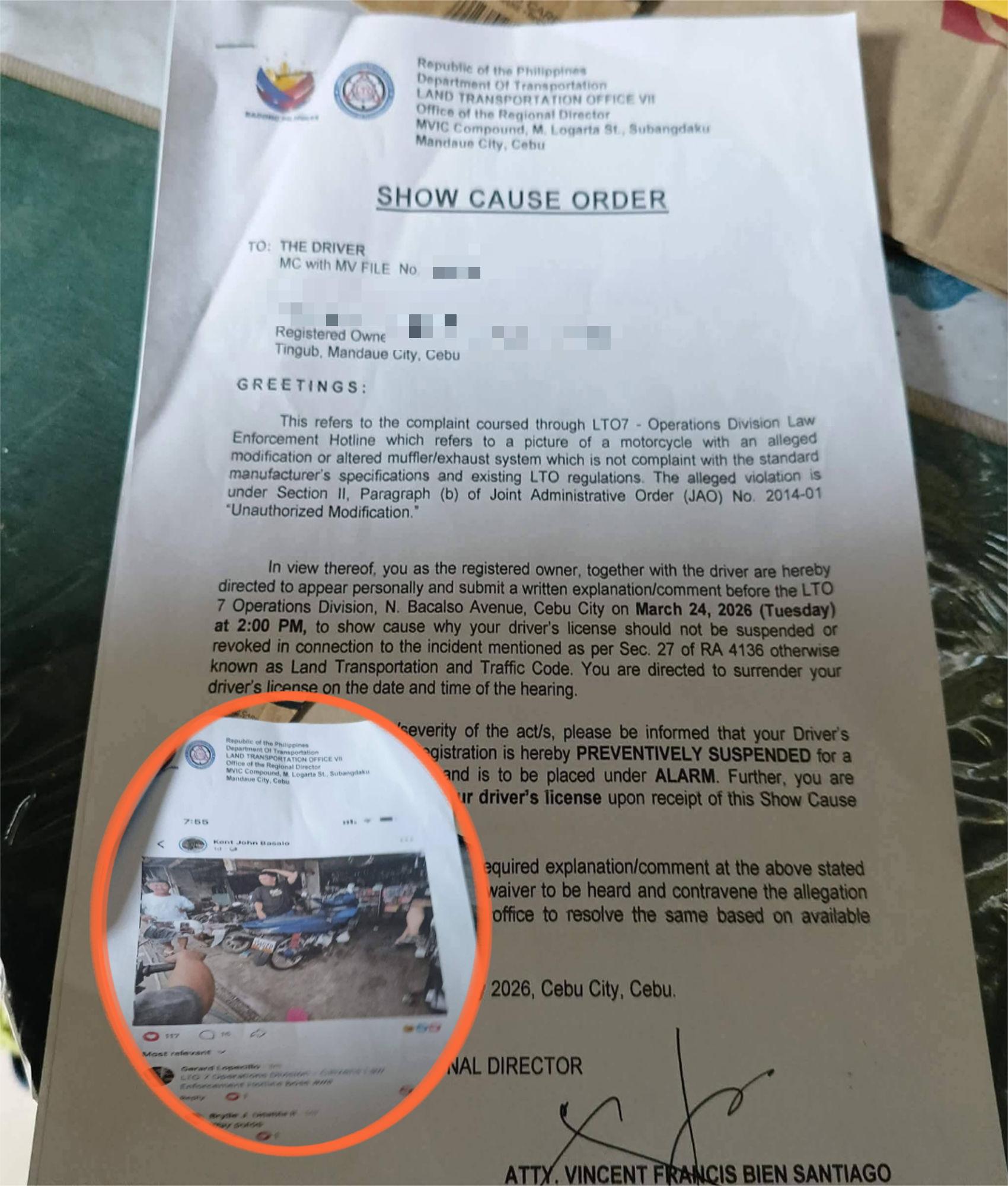
MANDAUE CITY, Cebu — A motorist from Mandaue City is facing administrative penalties after the Land Transportation Office (LTO) issued a show cause order based on a photo he posted on Facebook showing his motorcycle equipped with a modified muffler.
Brylle J. Unabia II was summoned to appear before LTO Region 7 following the viral circulation of the image online. According to the agency, the post raised concerns that the motorcycle might be operating with a modified exhaust system, which could potentially violate existing regulations on vehicle modifications.
As part of the administrative action, authorities temporarily suspended both the rider’s driver’s license and the registration of the motorcycle for 90 days. He was also ordered to appear at the LTO office along N. Bacalso Avenue in Cebu City on March 24 to provide an explanation regarding the incident.
However, Unabia has defended himself, stating that the motorcycle shown in the photograph had not yet been used on public roads. According to him, the unit was merely displayed online and had not been driven outside for actual road use. He argued that the image alone should not automatically be interpreted as proof that the vehicle violated traffic rules.
The case has sparked discussion among motorists and online communities about the growing role of social media in law enforcement. In recent years, authorities have increasingly used online posts, photos, and videos as evidence in identifying potential violations—from reckless driving to illegal vehicle modifications.
Supporters of the enforcement say it shows that accountability now extends beyond the physical road. They argue that public posts revealing possible violations can help authorities prevent dangerous practices, especially modifications that create excessive noise or compromise road safety.
Critics, however, question whether a social media post alone should be enough to trigger penalties before clear proof of an actual violation on the road. They warn that without careful verification, such actions could create a precedent where online appearances are judged as reality.
The situation illustrates how digital spaces are increasingly intersecting with real-world law enforcement. What people post online can now carry legal consequences, even when the context behind those posts is still under dispute.
As authorities continue to monitor social media for potential violations, the question becomes more complex: where should the line be drawn between public accountability and presumption of guilt?
If a vehicle violation has not occurred on the road, should a social media post alone be enough to trigger penalties from authorities? (Larawan mula: Brylle J. Unabia II / Facebook)