
11-year-old exposes CamSur official’s reign of rape, threats — innocence vs impunity in the barangay
Marijo Farah A. Benitez • Ipinost noong 2026-04-02 09:05:47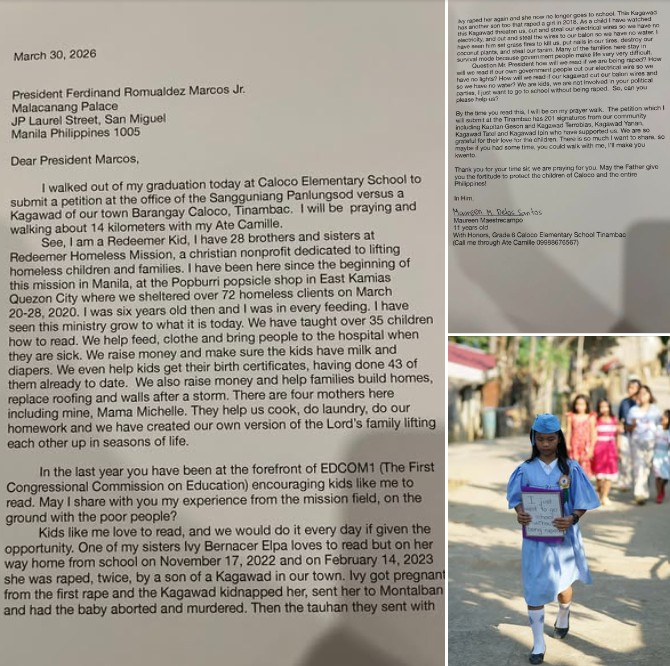
APRIL 2, 2026 — An 11-year-old girl’s handwritten plea to President Ferdinand Marcos Jr. has shaken the nation, forcing the government to confront allegations of rape, harassment, and abuse by a barangay councilor in Tinambac, Camarines Sur. The president’s emotional response and the deployment of police highlight both the urgency of the case and the broader crisis of child sexual violence in the Philippines.
On March 30, during what should have been a joyous graduation ceremony, an 11-year-old Grade 6 student walked out of her school in Barangay Caloco to deliver a petition to the vice mayor. Her letter, later posted online by Redeemer Homeless Mission, accused a local councilor and his sons of rape, harassment, and community intimidation.
Her words were raw and devastating: “Question Mr. President how will we read if we are being raped?”
The letter went viral, shared thousands of times, and quickly reached Malacañang.
President Marcos admitted the letter left him “close to tears” and “very angry.” He promised protection, education support, and immediate police deployment. The Philippine National Police (PNP) confirmed that a rape case involving one of the councilor’s sons had already been filed in 2023 and is under trial, with the accused detained at Tinangis Penal Farm.
This case is not isolated. A national baseline study in 2015 revealed that nearly one in five Filipino children aged 13–17 had experienced sexual abuse. Hospital-based child protection units continue to receive thousands of complaints each year.
The Department of Social Welfare and Development (DSWD) has now stepped in, offering psycho-emotional counseling and financial aid to the girl and her shelter companions.
But while the president’s intervention is commendable, it also exposes how fragile protection mechanisms are at the local level. Why did it take a child’s viral letter to mobilize national action?
The politics of survival in barangays
The girl’s accusations go beyond sexual violence. She described how the councilor allegedly cut electrical wires, severed water connections, and threatened families into submission.
“Many of the families here stay in survival mode because government people make life very difficult,” she wrote.
This paints a disturbing picture of barangay politics where officials wield basic utilities as weapons of control. For ordinary Pinoys, especially the poor, this is not just abuse of power; it is the stripping away of dignity and survival.
Marcos’ emotional reaction — “close to tears” and “very angry” — was widely shared online. His promise to ensure the girl’s education and safety resonated with many.
The president’s swift action contrasts sharply with the sluggishness of local governance. It raises questions about accountability. Why did barangay and municipal authorities fail to act earlier? And will this case lead to systemic reforms, or fade once the headlines die down?
For us, especially parents, this story is gut-wrenching. It reminds us that child protection is not just about laws — it’s about enforcement, vigilance, and community courage. The bravery of an 11-year-old girl has forced the nation to look at itself in the mirror.
Her letter is more than a cry for help; it is a challenge to every adult, every official, every voter: Will we allow children to bear the burden of exposing abuse, or will we finally build a system that protects them before they are harmed?
An 11-year-old had to risk everything just to be heard. What does that say about the kind of country we are allowing ourselves to become?
(Image: Redeemer Homeless Mission | Facebook)