
Globe bets on Starlink’s direct-to-cell gamble — no signal, no problem!
Marijo Farah A. Benitez • Ipinost noong 2026-01-18 16:57:42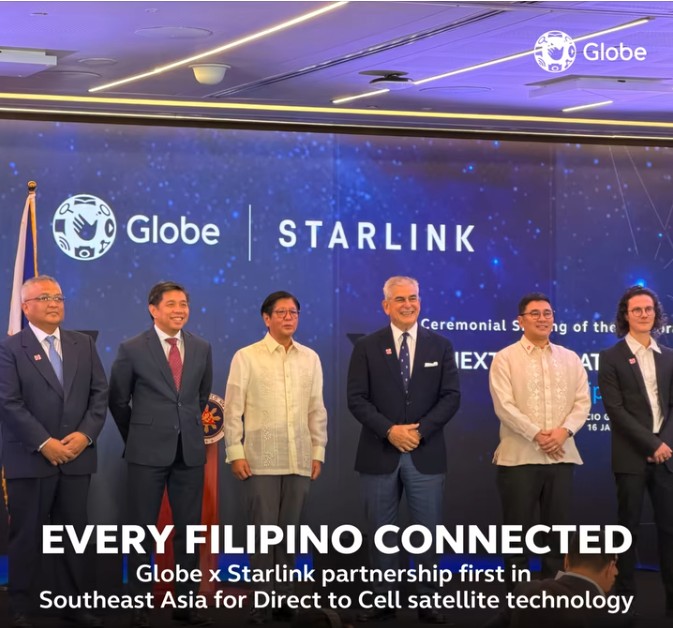
JANUARY 18, 2026 — Globe and Starlink just dropped a bombshell: your phone could stay online even in the remotest corners of the Philippines — no cell tower required. The new Direct to Cell (DTC) satellite service promises to connect LTE devices straight to the sky. Imagine being in the Cordilleras, the middle of the sea, or a sitio in Mindanao where “no signal” has long been the default, and suddenly you’re scrolling Facebook or sending GCash. Game-changer, right?
As Globe President and CEO Carl Cruz put it, “This is a landmark event for the Philippines. It puts us on the global map. One of only eight countries where the service is being offered is now in the Philippines.”
That’s not just corporate bragging — it’s a statement that connectivity is now a national issue, and the Philippines is finally catching up.
Globe says the service will automatically kick in once your phone loses signal, as long as you’re registered and roaming. Abroad? Same deal, if Starlink is accessible there.
Gerhard Tan, Globe’s Senior Director for Technology Strategy, explained, “If you are a partner of Starlink like Globe, and if you go abroad and there is no signal in that area, once you are subscribed to that promo, you can get access.”
Sounds like a dream.
DICT Secretary Henry Aguda is optimistic, saying “Once they launch this, buong Pilipinas may connectivity na. I think the challenge nila Carl ngayon is just to sustain the affordability they are offering.”
(Once they launch this, the whole Philippines will have connectivity. I think Carl’s challenge now is just to sustain the affordability they are offering.)
Affordability — that’s the word that should make us all lean forward. Because what good is a satellite-powered phone if the masa can’t afford the subscription?
Globe promises it will be “affordable” and even admits it won’t profit at first. But we’ve definitely heard that line before. Will this be another premium service only accessible to the middle class and above? Or will it truly democratize connectivity for farmers, fisherfolk, and students in far-flung barangays?
Let’s also not forget the bigger picture.
Cruz himself admitted, “We need the fiber network. Simple because in the advent of AI, the data traffic projections will be probably not only twofold, but probably 10-50 fold moving forward.”
Translation: satellites alone won’t cut it. Fiber and cell towers are still essential.
Aguda coutered, saying “Bakit kailangan pa ng fiber optic cable? Ang fiber optic cable kailangan natin yan para sa loob ng bahay, sa loob ng building maganda ang signal. Bakit kailangan pa natin ng mga mobile towers? Kailangan pa rin natin yan for outdoor signal.”
(Why do we still need fiber optic cable? We need it inside homes and buildings for good signal. Why do we still need mobile towers? We still need them for outdoor signal.)
So here’s the debate we should all be having: is this satellite service a genuine equalizer, or just another shiny tech promise that risks widening the digital divide? Will Globe’s billion-dollar capital expenditure this year translate into real, affordable access for the masses — or will it remain a headline that looks good on paper but leaves rural Filipinos still climbing trees for a bar of signal?
(Image: Globe Telecom | Facebook)